Navigation

Showing posts with label science. Show all posts

Friday, December 19, 2014

Books and Scientific Research Publications

Many of my friends don't enjoy reading unless necessary. They'd prefer spending time watching a film adaptation, if available, or resorting to other activities instead. I constantly hear "I don't have time to read" or "It's too boring." Personally, reading has been a very rewarding solitary experience. I follow at least a dozen book-based blogs on tumblr and can spend hours at bookstores. I read while I eat. I read when I wait for a tardy friend. I read when a meeting starts late. I read when I have awkward hour-long gaps between classes. There are small time slots sporadically laid out in my schedule that give me the option to delve in a chapter here and there, and I love it. This is just some motivation for non-readers who can befriend beautiful words from a raconteur and potentially have a life-changing experience from giving yourself a chance to interact with the text.

(Side note: I started a phase of binge reading 12 days before the end of my final exams this fall quarter and read three books total by the time my exams ended. Sometimes I really wonder where I find all the time to read so much, but it really is my primary method of de-stressing in such a pressuring few weeks.)

Words are truly phenomena all on their own. I stumbled upon this while browsing tumblr the other day:
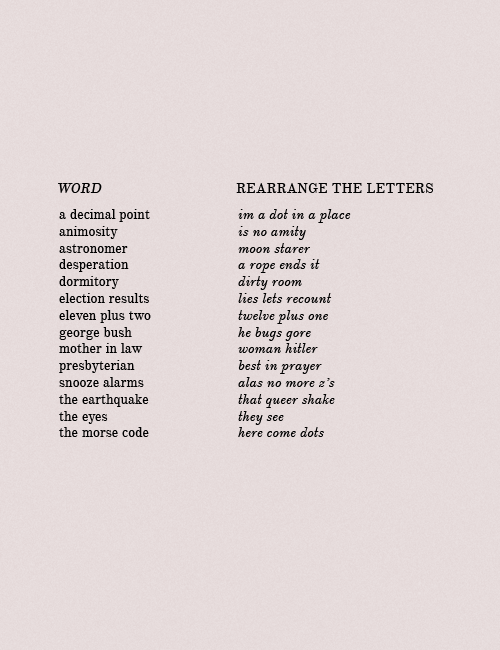
That's pretty mind-blowing.

However, there is one writing format that I find difficult to enjoy, and also sheds light on why the science community seems so disconnected from the general public. In my mineralogy and structural geology courses, I spent a good amount of time dissecting articles from scientific journals. I came to two very contrasting conclusions:
  • I have a much higher appreciation for the work that goes into scientific research. The procedures and in-depth studies take an advanced level of expertise and dedication to reach a sound understanding from the hypothesis. 
  • Scientific journal publications are extremely difficult to comprehend. Even as a student who is interested in the geosciences, I found myself very distanced from the text.
Reading these research publications made me feel the vital need for more science communication and interactive methods to bring about more comprehension for the seemingly chimerical scientific research.

There are many science writers who are brilliant at their craft; Michael Pollan and Kristin Ohlson are some of my favorites. However, their work simply cannot be compared with research journal publications. The nature of the works is far too different. The target audience for each is also different, which can qualify the contrasting styles. However, Pollan and Ohlson are not firsthand science researchers. They are the ones who do their fair share of interviewing and comprehend the latest understandings in science research and experimentation and publish coherently structured and beautiful books for the public to read. We need more Pollans and Ohlsons.

I am absolutely in favor of reading no matter the book genre or medium of reading (kindle, paperback, or hardcover? Everyone has their own preference), but I am realizing the general sway away from reading about science. A couple months ago, I told my roommate that I actually enjoy writing; my roommate, who is an engineering student, blatantly told me that the furthest I will get with anything science-writing related is publishing research articles. Is this the mindset that accompanies science? This perspective must change.

Saturday, October 19, 2013

"Will you be back again soon?"

Despite the incessant studying that has been accompanying my inflexible school schedule with midterms and quizzes which has caused my recent exhaustion, I re-discovered a former beacon of hope that brought the biggest smile to my face, contentment, and peace within: enlightening younger students, inspiring them to learn, and seeing their exciting responses and participation.

I'm not going to lie: the transition to being BEAM president has been tough. It's funny how you can work for months towards something, and it can all come crashing down within a few seconds due to unexpected complications. But I get it; this is all a part of the learning process. Disappointment and shattered plans are all naturally a part of a growing team that is learning to optimize its success and opportunities.

For the first time in several months, I visited a fourth-grade classroom and saw bright, curious faces who were so excited to be doing some hands-on science. While leading the class discussion, I asked them some questions related to osmosis and diffusion. What happens to your fingers when you guys are in the shower for too long? Can you relate that to what happens in Mr. Potato when he has been in salt water for too long? Every question I asked resulted in an astounding number of hands raised, all competitively eager to answer me (about 80% of the students raised their hands after every question). Well, how different this is from college science students; we're often very mundane and almost always sound wearied. Entering a room filled with enthusiastic young kids was incredibly refreshing. 

At the end of our session, several of the kids ran up to me with pleading, widened eyes and said, "Jessica, will you be back again soon? PLEASE?" I then announced to the class that we will be back next Friday. A roaring "HOORAY!" echoed throughout the room.

Going to the school is like seeing the fruits of the BEAM team's labor. And this motivates me to build an even stronger leadership which will continue reaching out to younger students, exposing them to the exciting and relateable aspects of science.


Did I forget to mention that the kids were excited to show off their class pet, Leo?

Friday, September 6, 2013

Circular schooling


"I would change that to a system where we reward mastery of the subject matter, rather than grading on a curve... We are wasting a lot of human potential." 
- John Matsui

"We need to create opportunities to excite students about how math and science connect to real life." 
- Freedman A. Hrabowski III

"We'd like kids to learn how to solve hard problems and what it takes to pull off a complex endeavor, how to plan, collaborate, fail and not give up."
- Paulo Blikstein 

"Science with humanity is googol times more amazing... I'd like to see STEM turned into STEAM."
- John Maeda

Friday, August 23, 2013

a brief manifesto on education and the future of our technologically-reliant society


“It must be a strange world not being a scientist—going through life not knowing—or maybe not caring about where the air came from, where the stars at night came from or how far they are from us. I want to know.” 

-Michio Kaku 


When I was 10 years old, I began to see the world of electronics unfold around me. Gradually, many of my friends were excited at the process of obtaining their own cell phones; I remember the Motorola Razor was in style when I was in middle school. Today, I look around and see 10 year-olds using smartphones to check Facebook and play games. As computers, cell phones, tablets, and other electronic devices continue to play an increasingly eminent role in the development of modern society, it is important that young students gain a better understanding of how these devices work as to understand the power of their roles in our everyday lives.

My parents gave me my first cell phone when I was in 6th grade. It’s the type of phone that has become termed the “dinosaur”: a three and a half inch phone with a square screen measured about half an inch on each side with large pad-dialing and no cover. I had been excited to finally have ownership of this thing I learned to call a cellular phone. In late elementary school, I was exposed to the world of computers, having typed my first assignment all by myself. I was fascinated by the huge monitor, the wireless mouse, and the CPU. As a kid, I had no idea how these devices worked, but I knew one thing for sure: they offered me an awful lot of convenience in life. Instead of walking in to an office near my bus stop to call my mom and tell her I was there, I could call her directly from my cell phone. Rather than trying so hard to write in a straight line as neatly as I could for my science poster, I could type on Microsoft Word, and even make my words fancy with WordArt.

For the past 18 years of my life, I have taken these electronic devices for granted. I use them daily for my social life, school, work, and other resources. During my pre-collegiate life, I was too familiar with the stereotype given to students who were interested in the details of electronics. They were termed geeks and nerds, and commonly labeled to have “no life.” The internet portrayed them constantly sitting in front of a computer with no rays of sunshine seeping through their windows. This falsified image is what initially drove me away from computing, and I even neglected my computer science classes upon entering college. However, after a year of meeting so many diverse individuals and finally taking my first computer language class (read my initial reaction to C++ here), I have grown to have tremendous respect for those who excel at computer science – the individuals who have allowed society to now rely on dependable devices.

As stated in this NY Times article which was published a few years ago, I believe that there are two major changes needed for the education of younger generations: the public perception of computer scientists which is ingrained in young students’ minds, and the need to implement computer science in their education so students can better understand the power it plays in their everyday lives. The UCLA Computer Science Project has had great progress and success in exposing high school students to the realm of computer science. The curricula emphasizes problem-solving through brainstorming and interpreting algorithms while incorporating social analysis concepts for students to better understand what computer science algorithms are realistic for today’s society.

I believe that the work of the UCLA Computer Science Project and other similar projects can be extended to younger students in elementary and middle school. At that point in their lives, kids are most curious about their surroundings and how things work. By learning algorithms at a young age, students develop logic and critical thinking skills, ultimately improving their skills in other subjects such as mathematics and even language arts. They could outgrow the idea of a geeky computer scientist frantically coding and gain more respect for individuals who ensure the development of safe technology for the general population and maybe, one day, become the person to form the next groundbreaking device for future generations. Perhaps these kids will develop a liking for making games or designing animations. One unknown success of the computer science world is the progress made in the Wireless Health Industry. The well-being of humanity is becoming even more dependent on the research in computer science areas. Athletes rely on wireless devices to improve their stamina and performances, and individuals are able to measure their heart rate and temperatures on-the-go without the need for overwhelmingly expensive equipment.

Students who are educated and inspired by computer science will ultimately gain skills and ideas that are worthwhile for a lifetime. The goal is not to be converting every child into a future computer scientist, but to have them understand basics in the world of electronics which is gradually becoming a core part of society. As more affordable and convenient devices are being developed and, most importantly, understood by the general public, computer science developments can not only changing the lives of those in Los Angeles and the United States, but the lives of people all over the world. 

Friday, August 2, 2013

"Engaging Young Minds"

Thursday, August 1, 2013 -

On behalf of BEAM with Perry, Liz, and Emily, I had the opportunity to participate in a panel, which was part of a 4-day teacher workshop, Engaging Young Minds. The audience of about 100+ mostly consisted of elementary school teachers. With the new state standards putting emphasis on the engineering design process and STEM in general, it is understandable that many educators feel anxious and slightly intimidated. I thought back to elementary school, when my teachers at each grade level were required to teach absolutely everything - Science, Math, English, History... even when they probably didn't specialize in that particular field! By introducing educators to BEAM and sharing our elementary school experiences with science, our goal was to show that science isn't such a terrifying subject. Science provides a plethora of opportunity to learn and enlivens curiosity within young children.

When we arrived at the venue, the first thing I noticed were the packages filled with indiscernible objects near front of the auditorium. I later learned that these materials were provided by Trash for Teaching. Educators were working on a hands-on project during the workshop with the materials. I loved the message conveyed: you can learn science with simple, everyday materials. There's no need to be spending big bills on fancy, enigmatic equipment.


The packages supplied by Trash for Teaching.
 The general outline of the panel:
  1. Presentation time! We opened up the panel by introducing some of the departments within the School of Engineering, transitioning to a brief talk on the Blackawton Bees study (all done by kids ages 8-12), introducing BEAM, and then sharing our experiences with science when we were in elementary school. 
  2. Demonstrations of some of BEAM's showcase lessons: stomp rockets, microscopes, zip-line balloon racers, rubber band cars, and lung models.
  3. Concluded with a fabulous Q&A session.
During the presentation, I learned something about myself: I've gradually grown out of my anxiety for speaking in front of large audiences. In the past, I gave presentations with smaller audiences of no more than 40 people. Being able to participate in a panel to share my thoughts and stories about a matter I care deeply about brought out a rather talkative side of me. And, most importantly, I realized how important it is to educate others about STEM, and how sciences and arts are inherently connected. Small sidetrack: I was talking with Liz and she mentioned how there was talk about "S.T.E.M" being adapted to "S.T.E.A.M." - science, technology, engineering, arts, and mathematics. I like that change - let's all start hash-tagging #STEAM in our twitter and facebook accounts.

Many of the teachers were intrigued and impressed by BEAM's student-designed lesson plans. Some spontaneously asked me for advice and feedback on their current lessons. How can I include hands-on experimentation with a topic like ecology? How should I have them better understand the concept of erosion? I then recognized my broad knowledge of science, creatively thinking of ways for elementary school teachers to incorporate the engineering design process in their curricula. It also delights me that teachers were interested in having passionate BEAM mentors visit their classrooms and work with their students.

After the panel, I reflected more about my education as a kid. In elementary school, I really did have great instructors who encouraged me to experiment with science and discover new things - we had science fair projects and Elmer's tri-fold posters to work with, hands-on activities with rocks and minerals, astrocamp... I definitely liked science when I was younger and realized how ubiquitous it is. The funny part: while this should have prompted me to pursue a degree in STEM fields, the fact that science is everywhere scared me. It felt like too much for me to handle at that time. Math and science were probably my weakest subjects when I was younger, and I didn't have the mindset to pursue those subjects then. I surprised myself when I selected Electrical Engineering as my major on all my college applications two years ago. So what happened in-between?

The major change took place in high school. Ironically, I was part of a humanities-based program in high school which put a lot of focus on writing. Every day, I was writing... writing about Nietzsche, Danto, existentialism, Jared Diamond's Guns, Germs, and Steel, and the list goes on. All this extensive writing fostered my critical thinking skills and helped me become a better communicator, and I am beyond thankful to my high school education for providing me these skills. I was also very lucky to have some great math and science teachers in high school. Three years of math with Mr. Butler and one year of physics with Ms. Blumfield (but really two years, considering how much I visited her classroom in senior year) sealed the deal for me. Despite some ridiculous homework problems (would I really slide my book on an icy surface and then calculate the conservation of momentum?), great instruction from 10th to 12th grade made me love physics and math. I even surprised my self by opting to self-study for AP Physics C in senior year.

While the discussion on Thursday did claim that students tend to make a decision about whether or not they like science in 3rd-5th grade, I know that there people like myself who didn't decide to pursue a career in STEM until their late teens. I never quite realized how the people around me played such a critical role in inspiring me about STEM, leading me to choose the career path I am pursuing today.


The lovely view from the 3rd floor of Boetler Hall.


And here I am, learning a little more every day, hoping that in the near future, I can contribute something beneficial for many communities I belong to.

Monday, July 8, 2013

scrumptious comp sci

From the deepest realms of my mind is where I must dig with passionate love and hatred in order to successfully write a C++ code. 

The human mind is a funky one. While a child may be extremely imaginative and undoubtedly creative, many may argue that a child lacks the patience to thoroughly rationalize information. As we grow into adults and encounter situations which require some sort of logical thinking process (maybe practicing common courtesy, or trying to figure out how an exam is attempting to trick us in every way possible), our brains supposedly reason more than they used to when we were toddlers. 

Reasoning with children is a difficult process. I'm not even referring to a school setting where it is nearly impossible to explain some basic grammar concepts to them without some fidgety kids here and there. Just think of a common scenario where a child insists on buying his/her zillionth toy of the week, having forgotten that there are other new toys lying idle on the floor at home. Then the parent is likely to try to reason with (or scold) the child. Fact 1: You just bought the same toy of a different color yesterday. Fact 2: Your toy is not broken. Conclusion: You may still go home and play with the same toy and (possibly) feel the same joy as you would if you owned a blue toy truck instead of a yellow one.


When I began learning C++, it certainly felt like I was instructing a child.. a very stubborn child who only obeys me if I speak to him/her in with the perfect voice tone and language. Forget one condition and this child goes wild. In a good (and a bad) way, this child called the computer is unable to throw emotional tantrums at me if I instruct it incorrectly. Yet I must spend hours, maybe days, trying to figure out exactly where I misspoke in addressing this child who only speaks one language at a time. Furthermore, there is this identification process the computer child makes with the ASCII table that took me far too long to figure out. Well, that's the setback of having a mute child who only communicates with me through error messages on a monitor..

For me to communicate with my computer child requires the utmost patience. This patience isn't a patience I must practice with someone or something else, but is a patience I must learn to have with myself. The computer child is an inanimate object. I can scream viciously at it when it refuses to compile and read my commands as I desire, but it has no reaction. In the end, I only frustrate myself further. 

Programming in C++ certainly requires concentration and self-control and really tests my level of patience. C++ is able to create simple "Hello world!" and mathematical calculations to some of the most powerful applications present today. What's fascinating (and equally draining) about C++ is its lack of abstraction. Every little detail must be coded in order for the computer to dissect the instructions we give. C++ forces me to think deep down and rationalize (the human ability to rationalize is a gift that many don't use... and I think it is often taken for granted). It's truly testing whether or not I know what I may think I know.

Well, C++, allow me to forget a semicolon or an equal sign for you to disobey my commands occasionally. One day, I will learn to communicate efficiently with you.

Tuesday, July 2, 2013

Throwback.. Summer 2011

The summer before my senior year of high school, I attended the Sci Art Nanolab. Looking back, I realize that I didn't understand most of the research taking place in the laboratories at the California Nanosystems Institute. Now a UCLA student pursuing an engineering degree, I'd like to think I've come a long way since my days at CNSI. I remember being in awe of the massive machines in the labs and the extensive computers present.

I was reviewing some old files on my computer when I ran into this gem. Throughout the program, we were required to write blog posts daily to draw connections between the arts and sciences based on certain presentations and guest lecturers. This blog post is about one of my favorite presentations from guest speaker Colleen Macklin.. here it is!
-----
As a dedicated musician, my mind suddenly sparked some intense interest and concentration when the second guest speaker in the evening spoke of her integration between the arts and science to teach something educationally through technological games. Colleen Macklin, the first speaker, spoke of how her game creations can be treated like a mathematical equation. The equation states “Game + rules = Emergence.” This made me realize how the boundaries present in a game can also serve as a way to release the creativity deep inside within a person when these borders are created, incorporating both art and science in the process. Musician Samuel Lover once claimed, “Circumstances are the rules of the weak; they are but the instruments of the wise.” The uses of both science and art are extremely effective when trying to stimulate the human mind to utilize reactions and paradigm shifts.

The existence of rules have often been scrutinized and hated by many people. Rules are often seen as the ultimate concrete barrier to break through; human beings like to ignore their existence. Playwright and critic George Bernard Shaw once said, “The golden rule is that there are no golden rules.” Yet, when such a principle for freedom is set, it seems as if the universe seemed too large and everybody else seemed so small—exactly how I felt after watching Hubble 3D at the California Science Center. When human beings are given too much freedom and no boundaries to be restrained within, it seemed as if our contributions are useless. However, if I were to look at things on a smaller sized scale and take baby steps to reach a bigger goal, these contributions eventually will make a difference, be it on a local scale or a universal scale.

The idea of rules and boundaries is what caused me to think about the changes and improvements that could take place if everybody would look at things on a smaller scale. For instance, a toddler would only be able to walk if he or she learned to take the smaller steps to be able to allow him or herself to be capable of physically moving on the Earth. The games presented today are just like taking baby steps on a miniature scale. I know that personally, as a human, I always want to take the shortcut and make it to my final goal in a shorter amount of time. Yet, I think rules like those set in interactive games force me to limit my goals and take the puny steps that would create a better final product. I was stimulated when I heard the professional musician state that she wanted to create a game that would allow people to learn something about music and the difficult theory behind it. I could relate to her personally; I am a musician and I find myself much better a performer than I am at understanding music theory. Those books from Keyboard Concepts that teach Deceptive and Augmented Cadences are some things I detest most about music. However, the actual music performance is entirely different, and knowing that someone wants to create an interactive experience with music through a game is inspiring. The game forces the player to have restrictions in the learning process, which is important; otherwise, the player might just want to know instantly how to play a Chopin Polonaise within an hour. Furthermore, the learning process is done in an exciting way. Games like Budgetball Colleen devised are exciting ways that create the borderlines for people to be able to take diminutive steps and gradually expand their knowledge on the current economic crises.

The devising of these games serves as one of the best examples of the integration of art and science. In addition, it has an educational purpose behind it and teaches patience, a quality necessary for both science and art.