Navigation

Showing posts with label books. Show all posts

Sunday, January 3, 2021

Thoughts on books: isolation, loneliness, and perception

I finished three books during the last two weeks of 2020: The Midnight Library, Where the Crawdads Sing, and Eleanor Oliphant is completely fine. Loneliness, isolation, and the feeling that those around us do not understand us, are common themes among the three books. I enjoyed all three to varying extents, my favorite being Eleanor Oliphant's story.

The Midnight Library by Matt Haig

While Nora's story in The Midnight Library conveyed a similar message, I found the plot rather predictable. However, there are still some nuggets of wisdom, which also felt like snippets of tweets I would expect from Matt Haig (a form of storytelling that doesn't create long-lasting character impressions for me). My favorite tweet-able lines from the novel:

The only way to learn is to live.

Doing one thing differently is often the same as doing everything differently

You will never live if you are looking for the meaning of life.  

You will never live if you are looking for the meaning of life.

It seems that many of us, especially my peers of the same generation, are always searching for meaning and purpose in our lives. Nora's story reminds us that by living our lives, we are already creating meaning and purpose in our every moment and action. Meaning and purpose is not something that we have to define clearly for ourselves, but rather is something that is always in our presence. We may not always see it there. 

I still consider Matt Haig's The Humans is one of my all-time favorite novels, though The Midnight Library didn't quite strike the same chord within me.


Where the Crawdads Sing
by Delia Owens 

I am still digesting this book as the ending has me rather perplexed. Kya's story reminded me that people are complex, there is no such thing as black-and-white as right-or-wrong, and that we all make choices that are ultimately rooted in survival. I rooted for Kya throughout the book because I see the pain she endured, the trauma, and the expectation of abandonment from those that are supposed to love her. Yet, Kya's pain (which I wish upon no one) is exactly what allows her to grow in ways that I admire. A contradiction of how life itself unfolds, I suppose. Despite her insistence that relying on others results in hurt, Kya's survival and growth was also inherently connected to others: Tate, who taught her how to read; Jumpin, who treated her like his own daughter; and Mabel, who was Kya's only female role model growing up. 

Perhaps Kya's story also reminds us that while we may think we cannot need others in our life for fear of pain and hurt, there are always those who built us up to who we are today that we may not consciously acknowledge.


Eleanor Oliphant is completely fine by Gail Honeyman

For the past week, I kept wondering why I am so intrigued by Eleanor Oliphant. When I read the first chapter, I sometimes found myself wishing that I could be a bit more in how she accepts the blatant realities of her life, clearheaded on the parts that don't make sense yet not accepted much by the negativity and perceived-stupidity of all that surrounds her. In some ways, I envied her way of thinking, minus her life-plan with the musician, which I perceived as coming from a place of fear and trauma. There is contemplation on the internet regarding Eleanor as being neurodivergent, which is not discussed explicitly in the book.

Gail Honeyman wanted to tell the story that stemmed from the lived experience of loneliness; how a young person "may not speak to another person from leaving the office on Friday night until returning on Monday morning. That this is possible when someone moves to a new city, rents a one-bedroom apartment, takes a new job where she has little in common with her colleagues..."

Eleanor's life is mostly isolated until she meets her new coworker, an emotionally intelligent Raymond. Gail Honeyman described him as the everyday good guy that is often left out of so many stories. 

I will leave you with this thought from Eleanor when she is at a social gathering, which is worthy of reflection as we move into 2021:

All of the people in the room seemed to take so much for granted: that they would be invited to social events, that they would have friends and family to talk to, that they would fall in love, be loved in return, perhaps create a family of their own. 

Saturday, February 16, 2019

"Behave": Genes, Environment, and Culture

I'm about halfway through Robert Sapolsky's "Behave", and I find this book fascinating. The witty bounce-off between comical language (especially in the footnotes) and data-backed evidence lightens the heavy topic of complex and downright confusing human behavior.

A topic from "Behave" that I have been perusing is gene-environment interactions, a topic strongly related to the age old debate of nature vs. nurture. How pivotal of a role do our genes play in explaining human behavior and preferences? How much do my genes determine my strong love for pancakes? 

There are two terms here that Sapolsky defines and, as he admits, are highly unintuitive: 
If genes strongly influence average levels of a trait, that trait is strongly inherited. If genes strongly influence the extent of variability around that average level, that trait has high heritability.
Sapolsky gives the example of height variation in a plant species with three gene versions. Version A will grow to be 1 inch tall, B to be 2 inches tall, and C to be 3 inches tall. In this scenario, the differences in height is completely determined by genes, and is thus 100% heritable. However, consider that this plant species always has leaves at the base closest to the roots, with an occasional anomaly of a plant with leaves at the top near the flowers. The trait of low-lying leaves would be highly inherited with low heritability; the genes predict the placement of leaves and don't explain the anomalous difference of leaves growing at the top of the plant.

So what drives differences, and how much of it is actually driven by genetics? I found Sapolsky's point about environment crucial: if you only study the gene in a particular environment, you fail to observe how the gene works in other environments. As expected, genes work differently in different environments. Furthermore, studying the gene in multiple environments decreases the influence of heritability, and suddenly the influence of genes on plant height is less due to genes and more influenced by environment. The actual heritability of a trait is highly context-dependent. Imagine the intricacies of studying human behavior in the context of environment, where there are infinite types of living environments, lifestyles, and traumas.

Related to gene-environment interaction is a topic that I took more personally: collectivist vs. individualist culture (or East Asian and American cultures, respectively). There are three scenarios in the book, which I used to "determine" how "Asian" and "American" I am:

1) Americans are more likely to remember when they influenced someone, while East Asians will remember times when someone influenced them. 
I'm 50-50. I have strong admiration and memories of mentors who have had significant impact on my decisions for my career and path forward, but I have equally strong memories of times when friends and acquaintances would remark on something I did to help them through challenges.

2) Which two go together? A monkey, a bear, and a banana. 
I instinctively said monkey and banana, associating a monkey with eating a banana. According to research, the cultural differences cause Americans to process this situation categorically; the monkey and bear go together since they are animals. East Asians, however, think about the relationship between a monkey and a banana; the monkey will need to eat the banana to nourish its body and survive.

3) When looking at a picture, what do you notice first? The scene or the person in the middle?
I tend to notice the person in the middle of a scene. Generally, Americans will look towards the center of the photo first, while East Asians look holistically at the entire photo.

What I found utterly fascinating is the environmental and ecological influence of rice on collectivism. Rice is the staple of East Asian food, and its harvesting requires extensive cooperation beyond family boundaries to successfully build and maintain rice irrigation systems. Rice harvesting is not a solitary activity. And on the topic of heritability and environment: a gene variant responsible for extroversion and impulsive activity occurs in 23% of Europeans and European Americans, but only 1% in East Asians. Collectivist rice farming societies trended against this variant as rice domestication progressed.

I couldn't help but think about my parents and how their actions strongly reflect collectivism. My mother makes lunch for my father every single day, and it is almost the exact same lunch: romaine lettuce with tomatoes, avocado, mushroom, many other vegetables, an egg, with bagel and oatmeal on the side. She always said it was natural for her to do so and she never had to think twice about putting together a meal for him. My father never complains about the meal, despite it almost being the exact same lunch every day.* I assume this is part of his "collectivist mindset", where he understands that every person contributes to the overall well-being of the family in some way. In turn, he does a lot of the cleaning in the house and likes to maintain garden and plants in the yard, keeping our family's living space clean.

My parents do all that without consciously dividing up tasks. To me, it seems like they naturally fell into those roles because they were aware of the individual contribution needed to create a healthy, communal environment for the family.

Genes, environment, and culture - the interplay among these three must somehow create a unique blueprint for every individual's behavior.


* If it were me, I might have resorted to making my own lunches because the individualist in me wants to take charge of my meals and have something other than nutritious, healthy salads daily.

Friday, December 19, 2014

Books and Scientific Research Publications

Many of my friends don't enjoy reading unless necessary. They'd prefer spending time watching a film adaptation, if available, or resorting to other activities instead. I constantly hear "I don't have time to read" or "It's too boring." Personally, reading has been a very rewarding solitary experience. I follow at least a dozen book-based blogs on tumblr and can spend hours at bookstores. I read while I eat. I read when I wait for a tardy friend. I read when a meeting starts late. I read when I have awkward hour-long gaps between classes. There are small time slots sporadically laid out in my schedule that give me the option to delve in a chapter here and there, and I love it. This is just some motivation for non-readers who can befriend beautiful words from a raconteur and potentially have a life-changing experience from giving yourself a chance to interact with the text.

(Side note: I started a phase of binge reading 12 days before the end of my final exams this fall quarter and read three books total by the time my exams ended. Sometimes I really wonder where I find all the time to read so much, but it really is my primary method of de-stressing in such a pressuring few weeks.)

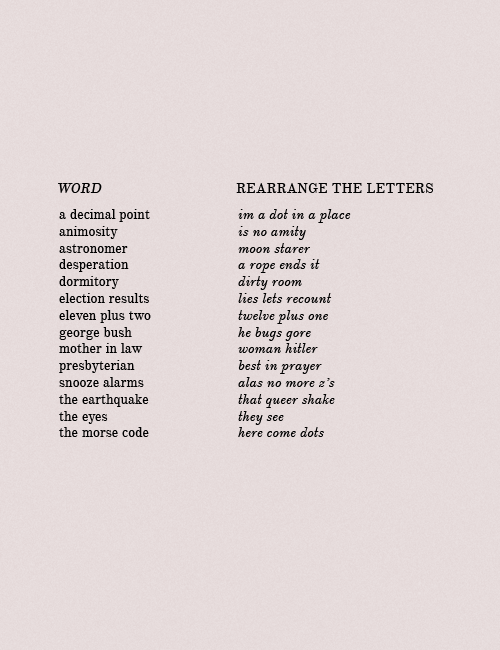
Words are truly phenomena all on their own. I stumbled upon this while browsing tumblr the other day:

That's pretty mind-blowing.

However, there is one writing format that I find difficult to enjoy, and also sheds light on why the science community seems so disconnected from the general public. In my mineralogy and structural geology courses, I spent a good amount of time dissecting articles from scientific journals. I came to two very contrasting conclusions:
  • I have a much higher appreciation for the work that goes into scientific research. The procedures and in-depth studies take an advanced level of expertise and dedication to reach a sound understanding from the hypothesis. 
  • Scientific journal publications are extremely difficult to comprehend. Even as a student who is interested in the geosciences, I found myself very distanced from the text.
Reading these research publications made me feel the vital need for more science communication and interactive methods to bring about more comprehension for the seemingly chimerical scientific research.

There are many science writers who are brilliant at their craft; Michael Pollan and Kristin Ohlson are some of my favorites. However, their work simply cannot be compared with research journal publications. The nature of the works is far too different. The target audience for each is also different, which can qualify the contrasting styles. However, Pollan and Ohlson are not firsthand science researchers. They are the ones who do their fair share of interviewing and comprehend the latest understandings in science research and experimentation and publish coherently structured and beautiful books for the public to read. We need more Pollans and Ohlsons.

I am absolutely in favor of reading no matter the book genre or medium of reading (kindle, paperback, or hardcover? Everyone has their own preference), but I am realizing the general sway away from reading about science. A couple months ago, I told my roommate that I actually enjoy writing; my roommate, who is an engineering student, blatantly told me that the furthest I will get with anything science-writing related is publishing research articles. Is this the mindset that accompanies science? This perspective must change.